Grade 1 End of Year Assessment Homeschool with Questions – Free Printable PDF
Grade 1 End of Year Assessment Homeschool with Questions – Free Printable PDF
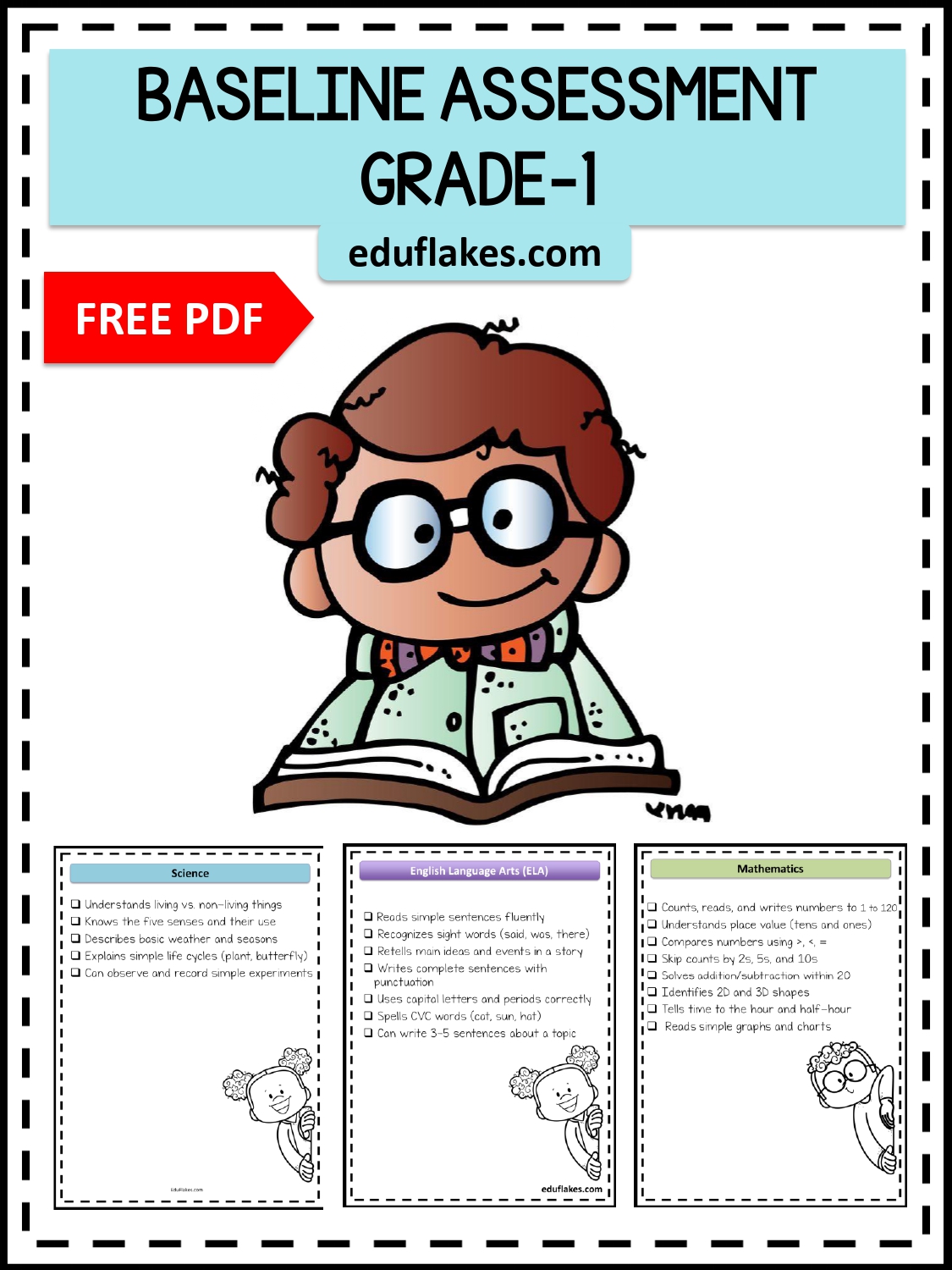
Assessing your child’s learning progress at the end of Grade 1 is an important step in preparing them for the next academic year. This Grade 1 End of Year Assessment (Homeschool Edition) is designed to help parents, teachers, and homeschooling families evaluate how well a student has mastered essential skills in English Language Arts (ELA), Mathematics, Science, and Social Studies.
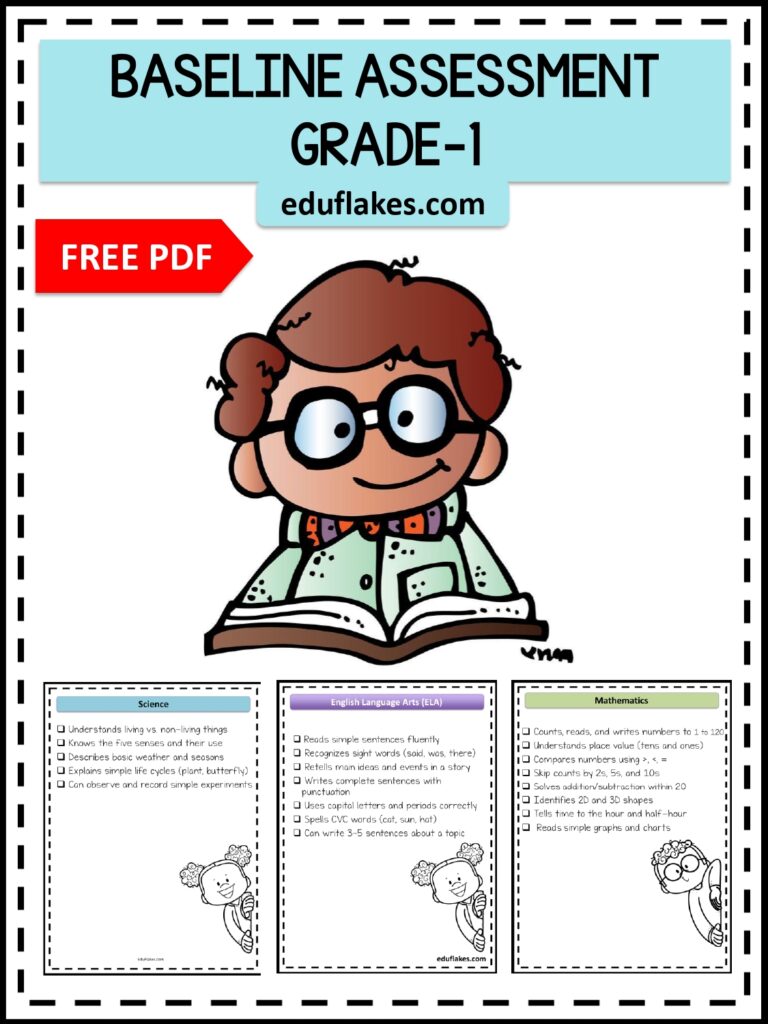
Created by EduFlakes.com, this printable free PDF assessment offers a well-balanced set of review questions and activities that align with U.S. curriculum standards. Whether you’re homeschooling or supplementing classroom learning, this assessment will give you a clear picture of your child’s academic growth.
📝 What’s Inside the Grade 1 End of Year Assessment
This free homeschool assessment includes five major sections, each designed to measure a different area of learning and personal development.
1. English Language Arts (ELA)
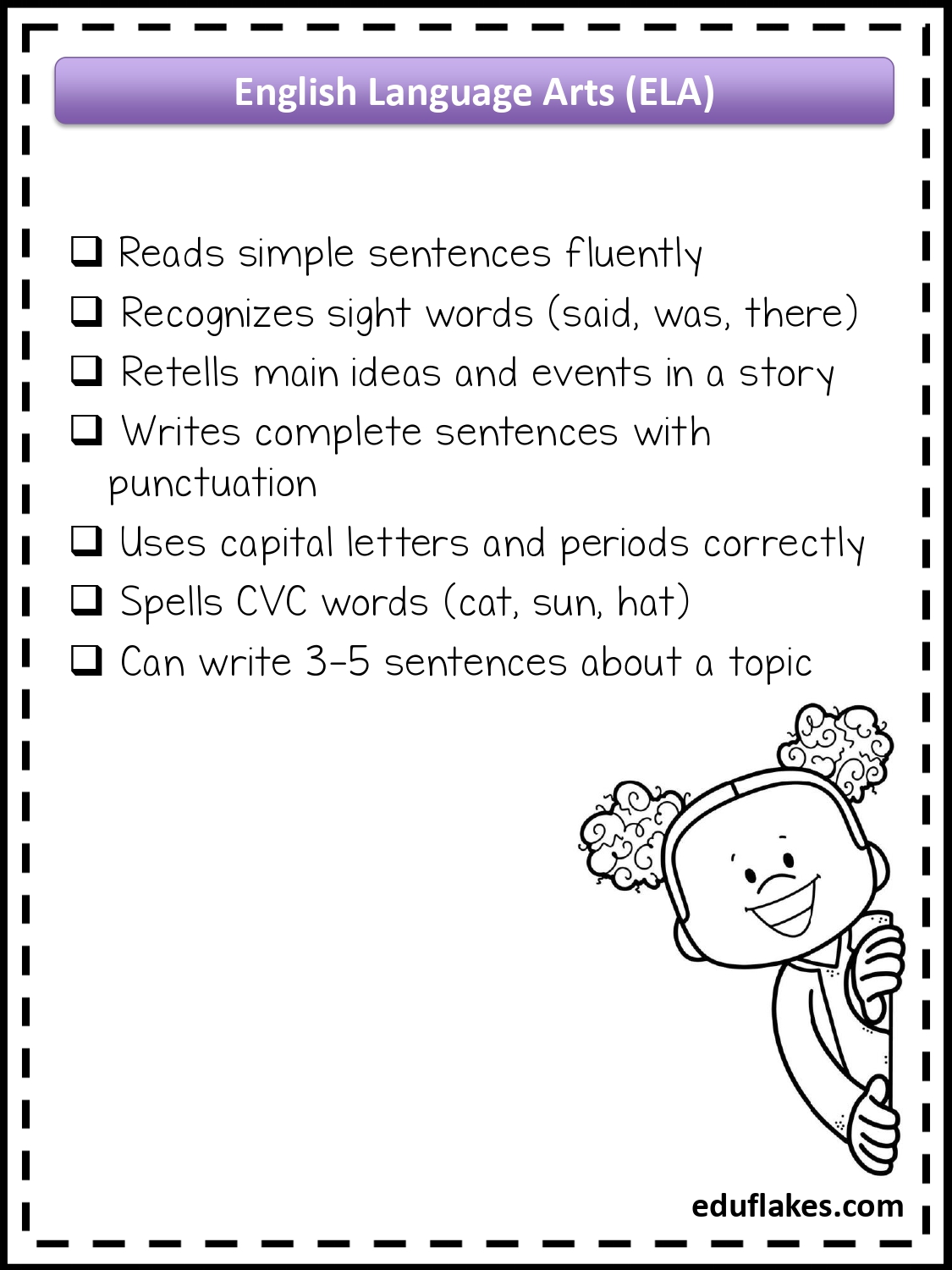
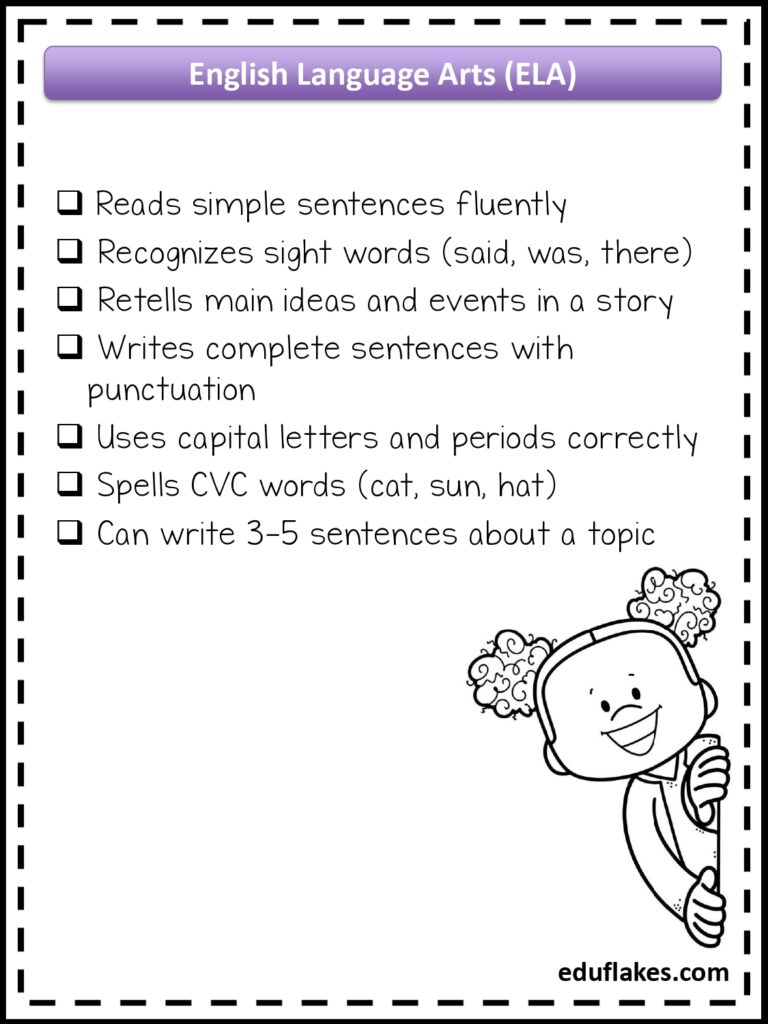
The English section focuses on reading comprehension, writing, and grammar fundamentals. It includes skills such as:
-
Reading simple sentences fluently
-
Recognizing sight words like said, was, and there
-
Retelling main ideas and story events
-
Writing complete sentences with correct punctuation
-
Using capital letters properly
-
Spelling CVC words (cat, sun, hat)
-
Writing short paragraphs about familiar topics
These tasks help evaluate reading fluency, comprehension, and basic writing ability — essential for early literacy success.
Example Questions:
-
Read: Mom is baking a cake. Who is baking?
-
Write 3 CVC words.
-
Retell a short story you know.
-
Circle the capital letter in: we went to the park.
This section ensures that your child can read with understanding, spell basic words, and write clear sentences — all foundational for Grade 2 readiness.
2. Mathematics
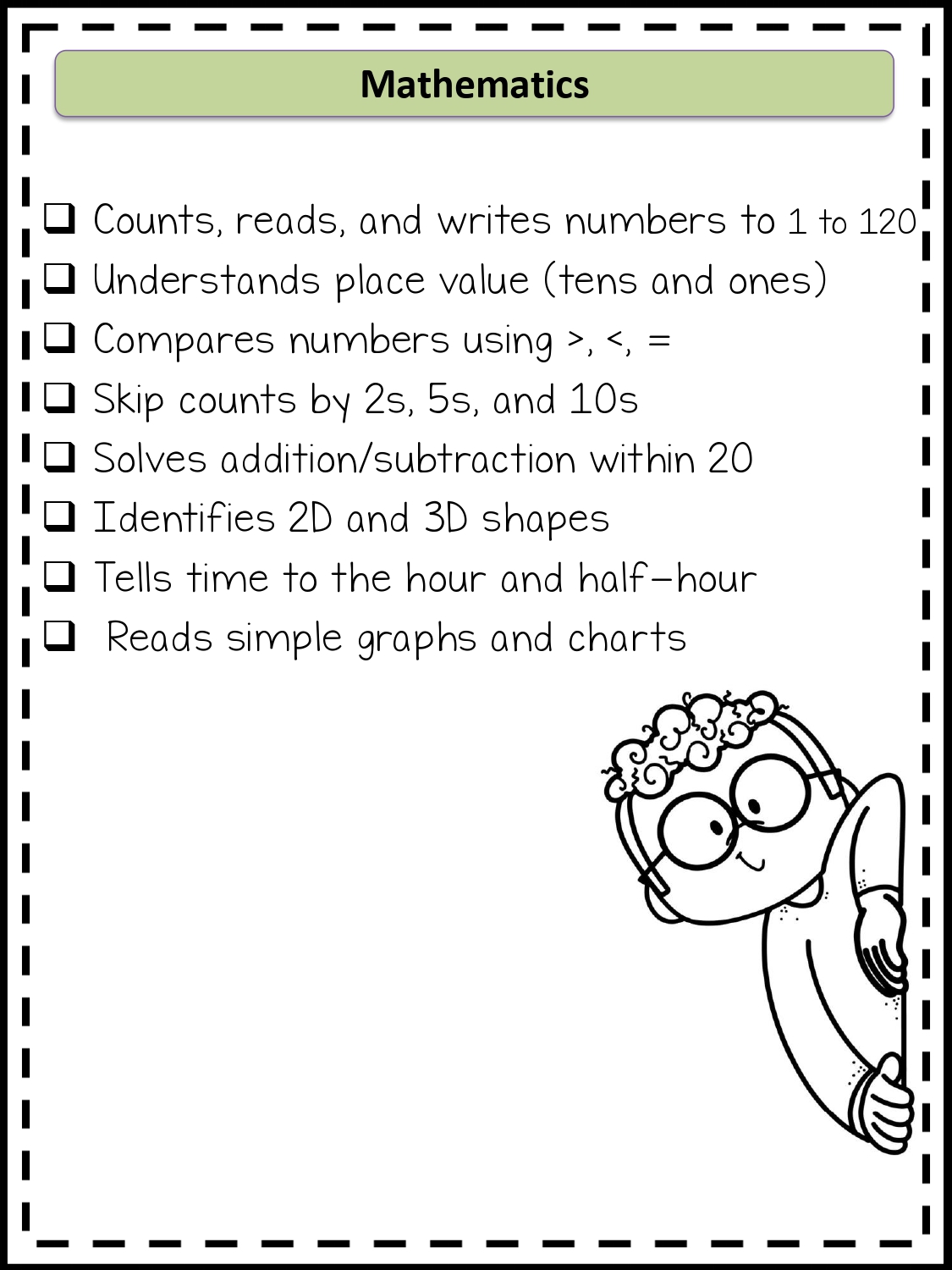
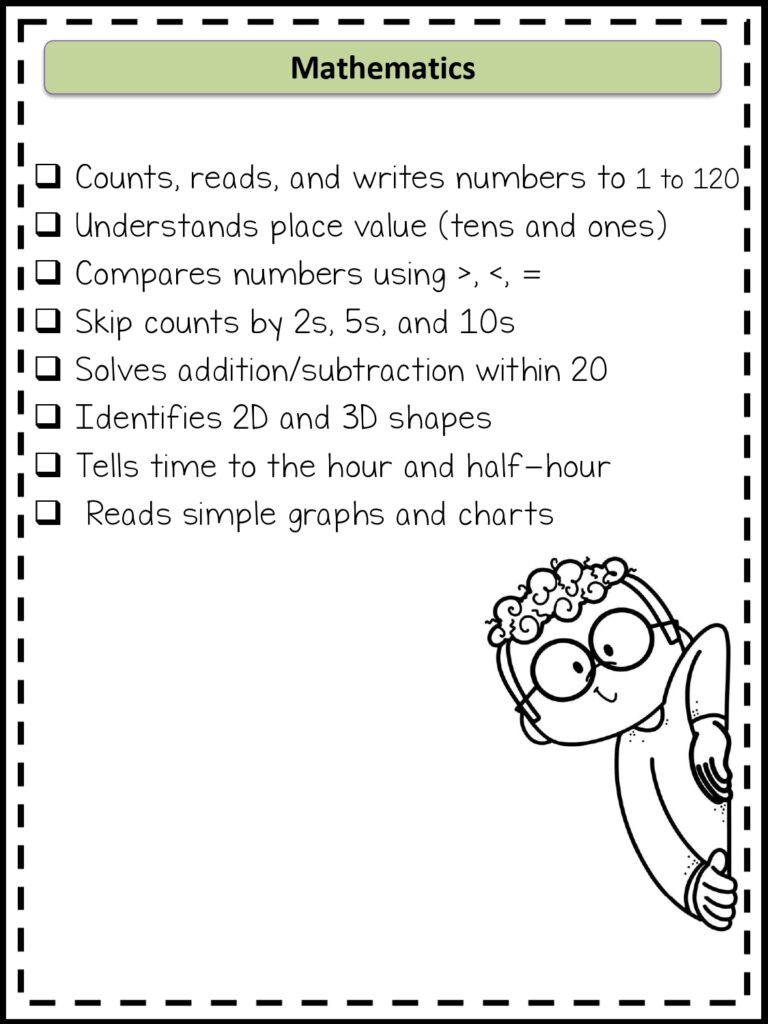
The Math portion of the assessment checks number sense, problem-solving, and logical thinking. Students practice with:
-
Counting, reading, and writing numbers up to 120
-
Understanding place value (tens and ones)
-
Comparing numbers using greater than, less than, or equal to symbols
-
Skip counting by 2s, 5s, and 10s
-
Solving addition and subtraction within 20
-
Identifying 2D and 3D shapes
-
Telling time to the hour and half-hour
-
Reading and interpreting simple graphs
Example Questions:
-
What comes after 79?
-
Solve: 7 + 8 = ?
-
Draw and name 3 shapes.
-
Make a bar graph of your favorite fruits.
These problems help assess your child’s numerical fluency and ability to apply math in real-world scenarios.
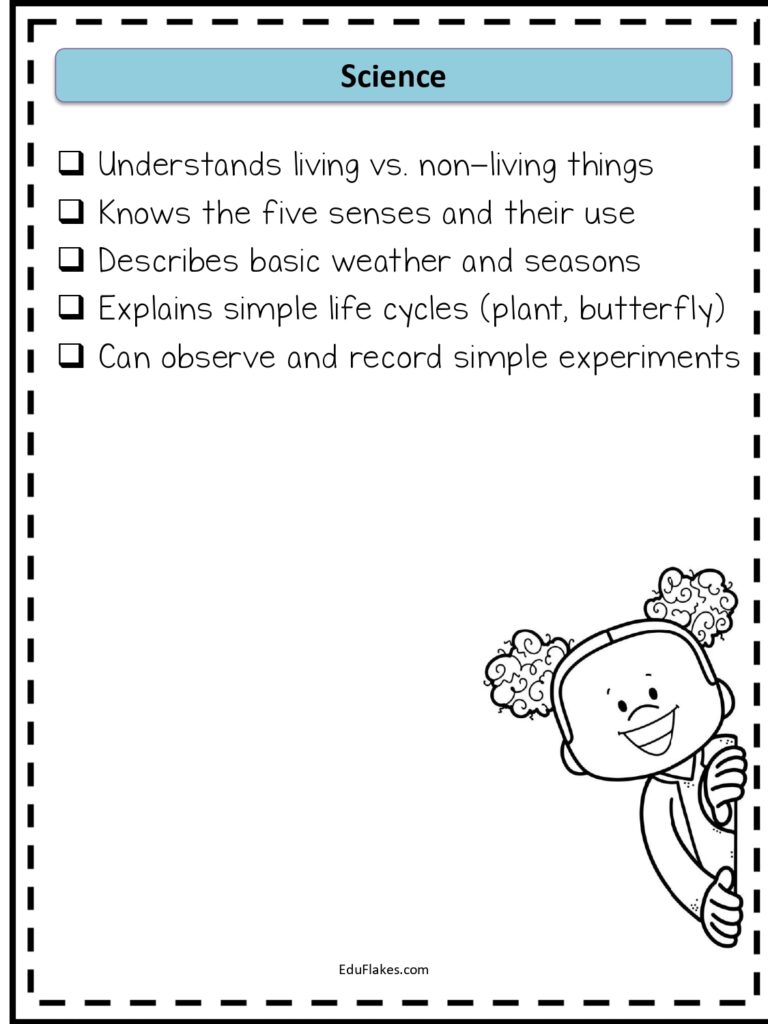
3. Science
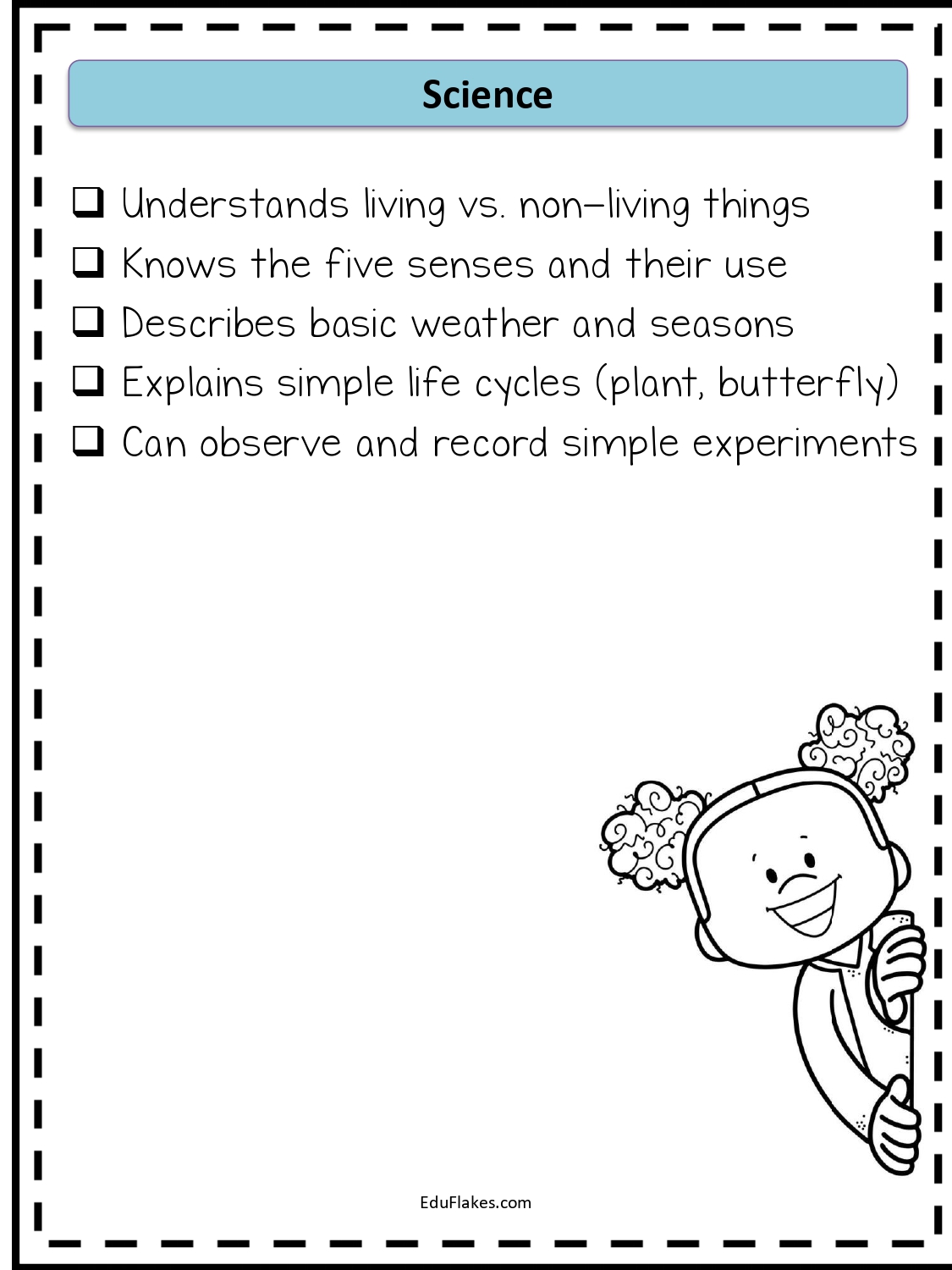
The Science section encourages curiosity and critical thinking through hands-on learning concepts. It covers:
-
Living vs. non-living things
-
The five senses and their uses
-
Weather and the four seasons
-
Simple life cycles (plants, butterflies)
-
Observing and recording basic experiments
Example Questions:
-
Name 3 living and 3 non-living things.
-
What sense do we use to smell?
-
What happens when ice melts?
-
Explain the life cycle of a butterfly.
This section helps evaluate your child’s understanding of the world through observation, inquiry, and exploration — key components of early science education.
4. Social Studies
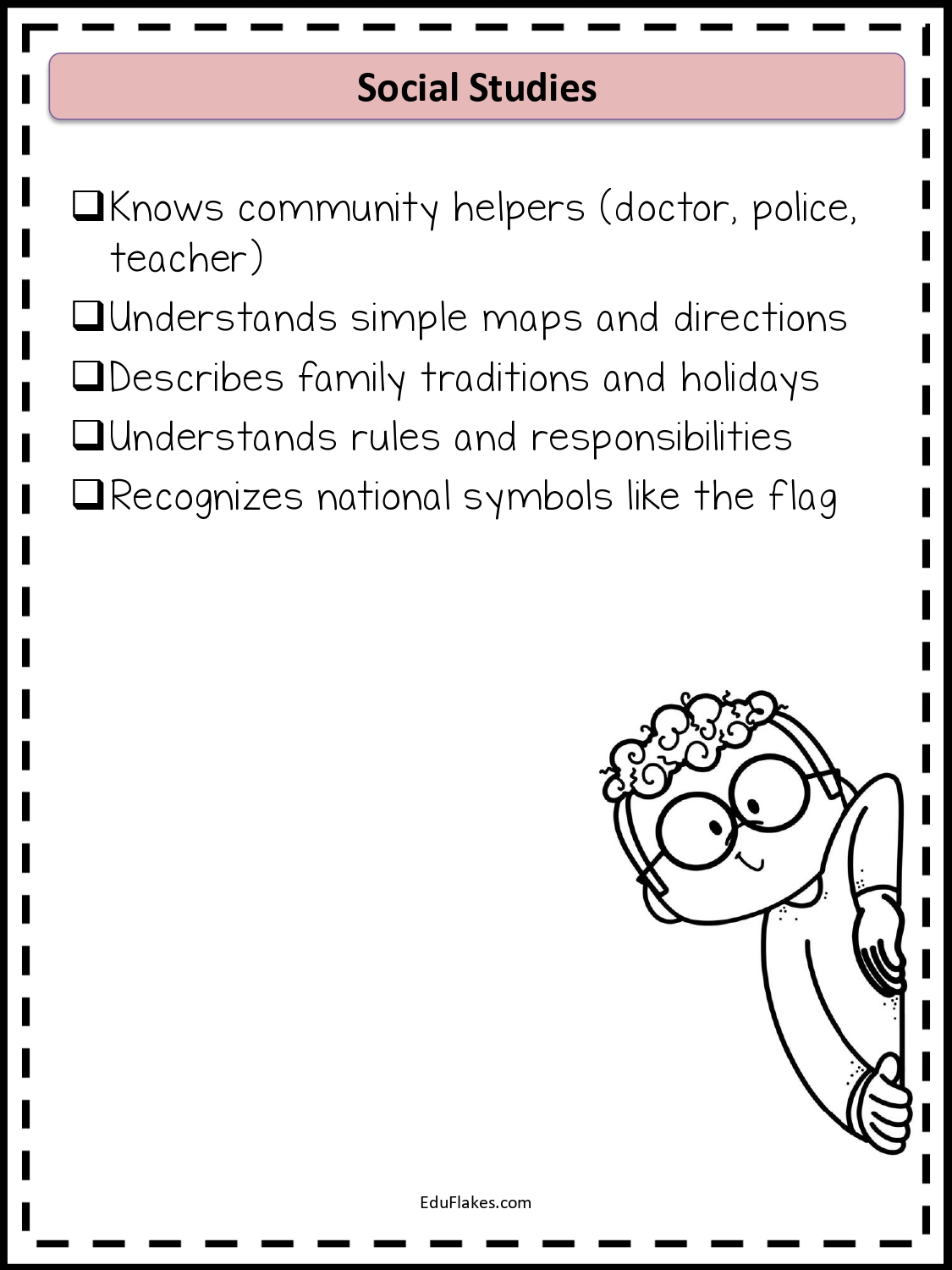
In Social Studies, students learn about people, places, and communities. The section includes:
-
Identifying community helpers (doctors, teachers, police)
-
Understanding maps and directions
-
Recognizing family traditions and holidays
-
Knowing basic rules and responsibilities
-
Recognizing national symbols like the flag
Example Questions:
-
Name three community helpers and what they do.
-
Why do we follow rules at home and school?
-
What direction do we use to find our way?
-
Draw your family celebrating a holiday.
This section builds awareness of community and citizenship — helping students appreciate their roles and responsibilities in society.
5. Personal Development and Learning Habits
Beyond academics, the assessment also emphasizes social and emotional growth, including:
-
Staying focused on a task for 10–15 minutes
-
Showing curiosity and asking thoughtful questions
-
Taking care of books and materials
-
Following directions independently
-
Working cooperatively with others
-
Trying again after making mistakes
Parents can reflect on their child’s learning habits and use this section to set goals for improvement.
Parent Reflection Section Includes:
-
Strengths
-
Areas to Work On
-
Next Steps and Learning Ideas
Suggested next steps might include:
-
Reading daily for 10 minutes
-
Practicing math through games
-
Encouraging journal writing
-
Doing hands-on science activities
🧩 Why End-of-Year Assessments Matter in Homeschooling
End-of-year homeschool assessments play a crucial role in measuring progress and setting learning goals. For Grade 1 students, it helps parents identify which academic areas need more attention before moving on to Grade 2.
Here are some key benefits:
✅ Evaluate Learning Progress
This assessment gives a full snapshot of your child’s academic achievements across all core subjects.
✅ Identify Learning Gaps
It helps spot areas where additional practice is needed, such as spelling, reading comprehension, or number sense.
✅ Build Confidence
By reviewing mastered skills, students gain confidence in their abilities and feel ready for the next grade.
✅ Plan Future Lessons
The results help guide future learning plans and summer enrichment activities.
✅ Create a Portfolio
Homeschool families can include this completed assessment in their year-end portfolio as proof of academic progress.
🎯 How to Use This Free Printable PDF
Using this Grade 1 End of Year Assessment is simple and flexible:
-
Download and Print – Get the free PDF and print it at home.
-
Set Up a Quiet Workspace – Choose a distraction-free area for your child.
-
Supervise and Encourage – Allow your child to answer independently but provide support when needed.
-
Review Answers Together – Go over the results and discuss what they learned.
-
Plan Next Steps – Use the reflection section to set achievable learning goals.
You can even make it fun by timing short sections, rewarding effort, or turning review sessions into games!
📚 Free PDF Download
👉 Download the Free Grade 1 End of Year Assessment (Homeschool Edition) from EduFlakes.com and get a comprehensive tool to measure your child’s learning success.

This printable PDF includes:
-
English, Math, Science, and Social Studies questions
-
Parent reflection and feedback section
-
Answer-friendly worksheets for hands-on evaluation
It’s an excellent end-of-year review for homeschoolers, teachers, and parents who want to ensure their child is ready for 2nd grade.
The Grade 1 End of Year Assessment for Homeschoolers is more than just a test — it’s a learning experience that helps you understand your child’s academic growth. With thoughtfully designed questions in all core subjects, it provides both a snapshot of achievement and a roadmap for improvement.
Whether you’re homeschooling full-time or supplementing school learning, this free printable PDF helps you close out the school year with confidence and clarity.
Use it to celebrate progress, identify strengths, and keep learning fun — because every child deserves to finish the year feeling proud of how far they’ve come.


Related products
-
-

-

-


Unicorn Coloring Pages
Activities -


Kindergarten FALL crafts and activities
Activities